Specification Checklist for Debranching Enzymes in Starch and Syrup Plants
Compare pullulanase specs for starch processing: activity, pH, temperature, dosage, COA/TDS/SDS, pilot trials, cost-in-use, and supplier checks.
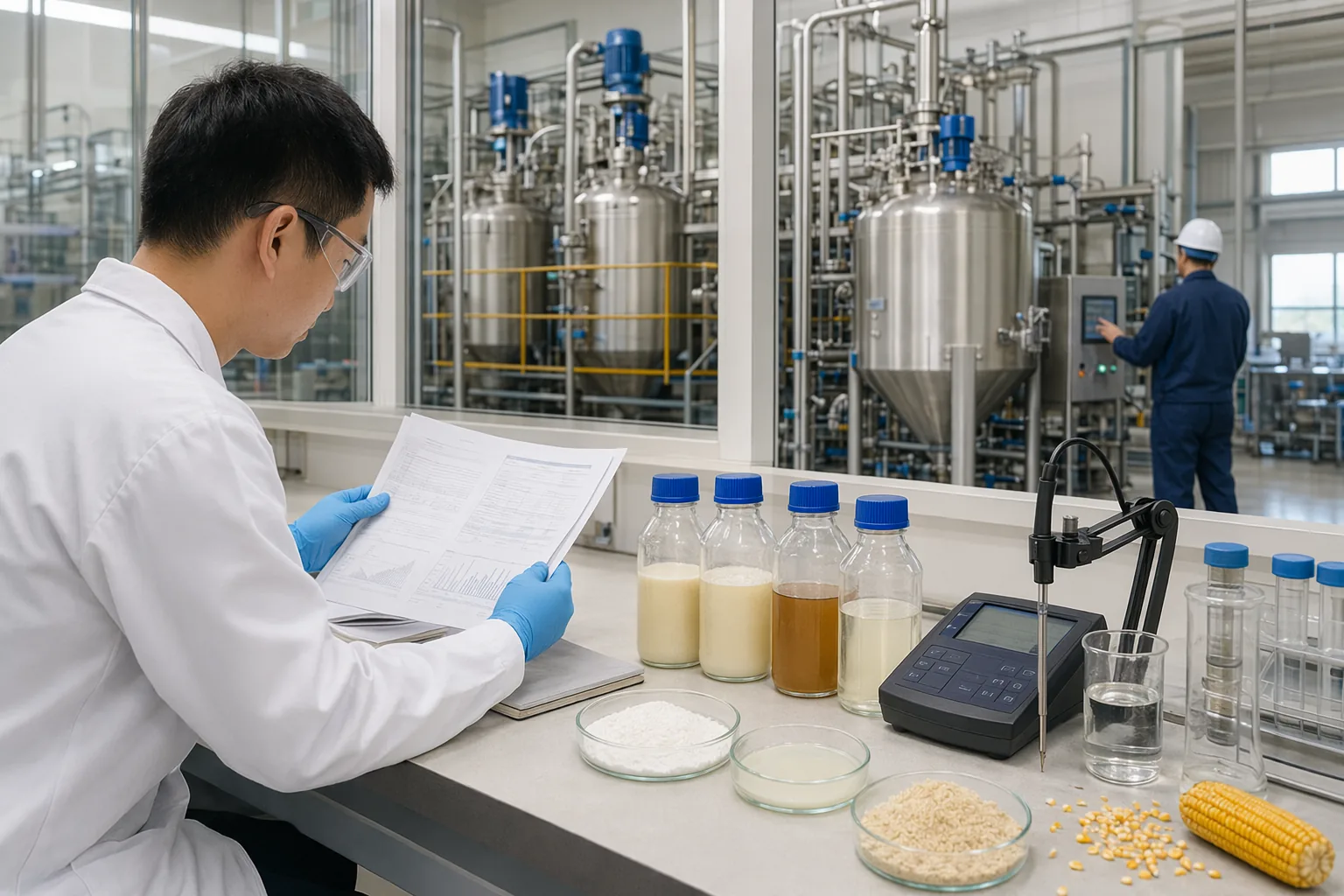
For starch, syrup and brewing-adjunct plants, the right debranching grade is not simply the one with the highest activity on paper. It is the grade that fits your pH, temperature, substrate, QC method and cost-in-use target. Use this checklist to compare offers, then send the product, quantity and destination for a quote.
Why Pullulanase Matters in Starch Processing
Pullulanase is a starch debranching enzyme that hydrolyzes alpha-1,6 linkages in amylopectin and related branched dextrins. In industrial starch processing, that pullulanase enzyme function can make saccharification more complete because glucoamylase or beta-amylase can access shorter, less-branched chains. Buyers usually evaluate pullulanase applications where the process target is higher dextrose equivalent, improved maltose formation, reduced residual limit dextrins, or tighter syrup specification. The enzyme is commonly considered after liquefaction, when starch has already been opened by alpha-amylase and the slurry is ready for controlled saccharification. For comparison, a general amylase cuts mainly alpha-1,4 bonds, while pullulanase function is focused on branch points. That distinction matters for dosage, timing, and QC. A good specification should define the substrate, operating window, activity unit, and whether the product is optimized for acid saccharification, brewing mashes, or syrup production.
Primary role: alpha-1,6 debranching • Typical use point: after liquefaction or during saccharification • Common targets: glucose, maltose, fermentability, and lower residual dextrins
Compare Operating Conditions Before Comparing Price
A pullulanase quote is only meaningful when the enzyme is compared under realistic process conditions. Many industrial starch systems screen acid-stable pullulanase in a mildly acidic saccharification window (this grade: pH 4.0–5.5 and 55–65°C), but the right window depends on the supplier strain, formulation, calcium sensitivity, substrate solids, and hold time. For high-dry-solids syrup production, viscosity, mixing, and residence time can change the apparent pullulanase activity in the plant compared with a lab beaker. Dosage trials start from each supplier’s recommended dose, converted to the same activity and dry-starch basis, then adjust by conversion result and economics. Compare candidates at the same pH, temperature, solids, DE after liquefaction, and enzyme addition point. If one product needs a pH shift, longer hold, or cooling step, include that operational burden in the comparison.
Screen at plant-relevant pH and temperature • Normalize dosage by activity and dry starch basis • Track residence time, solids, and mixing intensity • Include any required pH correction or heat adjustment
Specification Documents Buyers Should Request
For B2B procurement, the technical file is as important as the sample. Request a current Certificate of Analysis, Technical Data Sheet, and Safety Data Sheet for each pullulanase enzyme under review. The COA should show lot number, declared pullulanase activity, appearance, and microbiological or contaminant checks relevant to your application and region. The TDS should define enzyme source, activity unit method, recommended pH and temperature range, dosage guidance, storage conditions, shelf life, and compatibility notes with alpha-amylase, glucoamylase, beta-amylase, or protease if used. The SDS should cover handling, dust or aerosol precautions, and occupational exposure controls. Do not rely on marketing claims alone. Ask for typical lot-to-lot variation, retained-sample policy, change notification practice, and whether the formulation contains stabilizers, salts, preservatives, or carriers that may affect downstream filtration, color, or labeling.
COA: activity, lot data, and release checks • TDS: process window, dosage, storage, compatibility • SDS: safe industrial handling and exposure controls • Change-control information for supplier qualification
Production Route and Substrate Questions
The production of pullulanase with different agro wastes as substrate is often discussed because substrates such as wheat bran, rice bran, corn steep liquor, cassava residues, soybean meal, and other starch- or protein-rich side streams can support microbial fermentation. For industrial buyers, the key question is not whether an agro-waste substrate was used, but whether the pullulanase supplier can show consistent enzyme performance from batch to batch. Substrate variation may affect fermentation yield, impurity profile, color, odor, side activities, and downstream clarification needs. A practical comparison should include the producing microorganism, fermentation mode, activity assay, carrier system, and purification or concentration steps. In syrup production, these factors influence dosing confidence and process repeatability. Buyers should treat agro-waste substrate information as one part of supplier qualification, alongside specification limits, QC release data, and pilot-scale performance under real plant conditions.
Ask whether substrate sourcing and pretreatment are controlled. • Compare activity using the same assay basis whenever possible. • Check whether side activities affect starch hydrolysis profiles.
Pilot Validation and QC Checks
Pilot validation should reproduce the plant’s liquefied starch profile, not an idealized laboratory substrate. Build a trial matrix that compares at least two dosage levels, one control without pullulanase, and the current production enzyme program if applicable. Measure DE, glucose or maltose profile by HPLC if available, residual dextrins, viscosity, filtration behavior, color, pH drift, and final syrup specification. For brewing-related pullulanase industrial applications, wort fermentability, apparent attenuation, iodine response, and limit dextrin reduction may be more relevant than DE alone. Labs sometimes discuss using a pullulanase activity assay on wort or starch hydrolysate; whatever method is chosen, document sample preparation, temperature, incubation time, and calculation basis. A supplier’s declared pullulanase activity is useful for receiving QC, but plant performance must be validated against yield, cycle time, and consistency in your own substrate.
Run a no-pullulanase control • Measure carbohydrate profile, not only DE • Check filtration, color, and viscosity impacts • Use a documented activity assay for receiving QC
Liquid or Powder: Handling and Supplier Checks
A pullulanase supplier for syrup production should provide more than a quoted activity number. Request a current COA for the offered batch, a TDS with recommended pH and temperature range, an SDS for handling and storage, and a clear description of the activity assay. If two suppliers use different activity definitions, direct unit-to-unit comparison can be misleading. Ask for retention samples, batch history, microbiological limits where relevant, heavy metal or contaminant statements when applicable to your market, and shelf-life data under recommended storage. For liquid enzymes, confirm preservative system, viscosity, and pumpability. For powders, check dusting risk, particle size, carrier, and dissolution behavior. Supplier qualification should also assess responsiveness, change notification practice, packaging integrity, and technical support for plant trials. A reliable pullulanase enzyme supplier for syrup production will support cost-in-use modeling rather than pushing dosage by brochure claims.
Require COA, TDS, and SDS before plant evaluation. • Ask how formulation changes are communicated. • Compare delivered activity, not only price per kilogram.
Cost-in-Use and Supplier Qualification
The pullulanase market includes products that differ in concentration, stability, formulation, activity method, and support model. A low unit price can be expensive if dosage is higher, conversion is slower, or the enzyme forces additional pH adjustment. Build a cost-in-use comparison from enzyme cost per metric ton of dry starch, yield change, reduced rework, energy impact, tank occupancy, filtration losses, off-spec risk, and inventory stability. Supplier qualification should include sample responsiveness, technical support quality, documentation completeness, lead time, packaging fit, storage requirements, and lot traceability. Confirm whether the supplier can support scale-up, troubleshooting, and change notification without implying unverified certifications. The strongest procurement decision balances technical fit and commercial reliability. For starch processing, pullulanase applications should be qualified as a process variable, not purchased as a commodity input based only on headline activity.
Compare cost per ton of dry starch processed • Include yield, time, energy, and rework effects • Assess lead time, packaging, and lot traceability • Qualify the supplier before full-scale conversion
Technical Buying Checklist
Line up every offer on the same sheet:
Operating window against your saccharification pH and temperature (this grade: pH 4.0–5.5, 55–65 °C) • Activity value with its unit definition and assay method (this grade: 1,000–3,000 ASPU/g) • Form, pack and storage (this grade: brown liquid, 25 kg or 200 L drums, 12 months refrigerated) • How the production route and substrate variation are controlled • Pilot result against a no-pullulanase control, converted to cost per tonne of dry starch
Request a Quote
Distributors, resellers and plant buyers can request a quote by sending three things: the product (grade or activity range), the quantity and the destination. Packs are 25 kg drums or 200 L drums with a 25 kg minimum order; price and lead time are quoted per order.
Pullulanase (Debranching Enzyme) for Research & Industry
Need Pullulanase (Debranching Enzyme) for your lab or production process?
ISO 9001 certified · Food-grade & research-grade · Ships to 80+ countries
Frequently Asked Questions
What is the main pullulanase enzyme function in starch processing?
The main pullulanase enzyme function is to hydrolyze alpha-1,6 branch points in amylopectin and branched dextrins. This debranching makes starch hydrolysates more accessible to enzymes that attack alpha-1,4 linkages, such as glucoamylase or beta-amylase. In practice, the result can be improved saccharification, higher target sugar formation, reduced limit dextrins, or better control of syrup and fermentation profiles.
How should buyers compare pullulanase activity between suppliers?
Do not compare pullulanase activity numbers unless the assay methods are equivalent. Ask each supplier for the activity unit definition, substrate, pH, temperature, incubation time, and calculation method. Then run pilot trials using the same starch hydrolysate, solids, pH, temperature, and hold time. The best comparison combines declared activity, actual conversion results, lot consistency, and cost-in-use under plant-relevant conditions.
What dosage should be used for pilot pullulanase applications?
Dosage depends on enzyme concentration, activity unit, starch source, liquefaction profile, target carbohydrate spectrum, and residence time. Start from the supplier’s activity-unit recommendation, expressed per tonne of dry starch. Pilot trials should include a no-pullulanase control and at least two dosage levels to identify the economic response curve.
Is pullulanase relevant outside starch syrup production?
Yes. While starch processing and syrup production are major pullulanase applications, brewing can also use debranching to influence wort fermentability and residual dextrin levels. The decision criteria differ by application: syrup plants may prioritize DE, glucose, maltose, filtration, and color, while brewers may track fermentability, attenuation, iodine response, and flavor-neutral processing. Each application still requires pilot validation and documented QC.
Is agro-waste substrate production always better for pullulanase?
Not automatically. Agro-waste substrates can be attractive fermentation inputs, but syrup producers should judge the finished pullulanase by activity consistency, impurity control, documentation, and plant performance. Different agro wastes may affect fermentation yield and downstream processing. Ask the supplier how substrate variability is controlled and compare pilot results under your own saccharification conditions before changing supply.
Turn This Guide Into a Supplier Brief
Request a pullulanase specification review and pilot-trial checklist for your starch processing line. See our application page for Pullulanase for Measurable Process Gains for specs, MOQ, and a free 50 g sample.
Contact Us to Contributehello@mail.enzymeimpact.com